You slipped on someone else’s property in Los Angeles. Maybe it was a chipped stair outside a Koreatown apartment, a puddle near the produce section at a Westwood market, or a sudden drop in a Downtown parking garage.
Then the insurance adjuster called and told you the hazard was obvious, so the fall is on you.
That argument stings because it sounds fair. You were there. You had eyes.
But “obvious” is a legal label with a specific meaning, and California handles it differently than many states.
So, can you still sue? Often, yes. An open and obvious hazard doesn’t automatically end a premises liability claim in California. It can reduce your payout and, in some situations, give the property owner a strong defense. We’ll walk through how the law works, where the exceptions kick in, and what to do next.
Key Takeaways
- An open and obvious hazard is a dangerous condition a reasonable person would notice and avoid.
- California doesn’t treat an obvious hazard as an automatic bar to a premises liability claim.
- Courts ask two questions: did the owner still have a duty to protect visitors, and how much fault is yours?
- Practical necessity, foreseeable distraction, ignored repairs, and safety-code violations can keep a claim alive.
- Video and records disappear quickly, and claims against public entities have a six-month deadline.
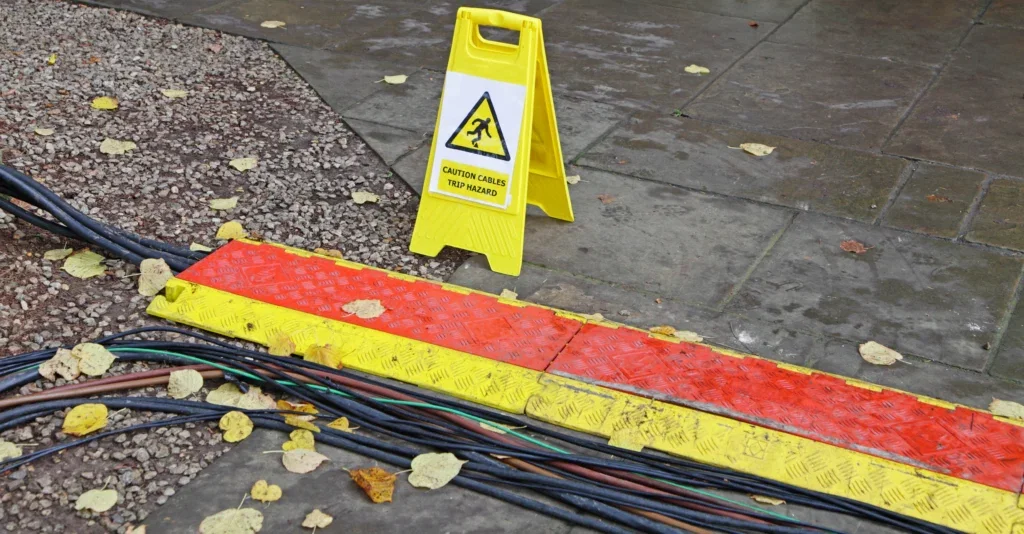
An open and obvious hazard is a dangerous property condition that a reasonable person walking by would spot and avoid. California doesn’t treat this label as an automatic game-over for your personal injury claim.
Property owners may skip posting warning signs for obvious dangers, but they still must keep their premises safe. If you get hurt, your lack of attention only reduces your payout.
The test is objective. A court focuses on what a reasonable person would have seen, not what you personally noticed in the moment.
A hazard usually counts as open and obvious when:
- It is visible: Shadows, dim lighting, floor clutter, or a store display doesn’t hide the danger.
- The risk is common knowledge: Most adults know wet tile is slippery or that an open trench on a sidewalk is a drop.
- No special tools are needed: A visitor could spot the hazard without inspection gear or training.
Defense lawyers love this list because it sounds bulletproof. But it rarely is.
Clear liquid spilled on glossy tile inside a brightly lit store is visible on paper but nearly invisible to someone pushing a cart. Visible and obvious aren’t always the same thing.
Why Property Owners and Insurers Lean on This Defense
Adjusters often raise the open and obvious defense early. Here’s why:
- It ends claims cheaply. A denial letter costs less than an investigation.
- It moves blame to you. “You should have watched where you were going” is easy to say and hard to hear.
- It works before the evidence shows up. Video footage, sweep logs, and repair records usually surface later, if anyone asks for them.
- It fits every setting. Retail falls, apartment stairs, and sidewalk accidents all get the same stock defense.
Keep that tactic in mind when you read a claim denial letter. It’s simply an opening negotiating posture designed to scare you off.
Common Examples of Open and Obvious Hazards in Los Angeles
Falls send millions of Americans to the emergency room. The National Safety Council counted more than 3.85 million ER visits for adults 65 and older in 2023.7
Insurers tend to call a hazard “obvious” after the fall, once everyone knows where to look.
These are the settings where that argument comes up most around Los Angeles.
Retail Stores, Malls, and Restaurants
Picture walking through a busy shopping center like Westfield Century City or The Grove. Banners hang overhead, music plays, and your kid tugs your sleeve.
In a setting built to distract you, an adjuster will still try to call these hazards “obvious”:
- Liquid spills in main grocery aisles
- Pallets or display corners sticking out into walkways
- Freshly mopped tile near exits during open hours
A store can say any shopper should see a pallet. Your lawyer would ask how long it sat there, who left it, and why nobody bothered to move it.
Apartment Buildings and Rental Homes
Koreatown renters, along with tenants in Hollywood and Downtown LA, often live in older walk-ups with outdoor stairs and shared hallways.
Common trouble spots include:
- Loose or missing handrails on concrete stairs
- Walkways cracked or lifted by tree roots on the way to the mailboxes or trash bins
- Burned-out hallway lights hiding a sudden step or uneven flooring
If those stairs are your only way out, you can’t just “avoid” them. That detail matters later in this guide.
Parking Lots, Garages, and Public Walkways
Outdoor falls raise another question: who owns the ground?
Common hazards include:
- Unpainted wheel stops, exposed rebar, and potholes in private garages
- Loose cables, temporary ramps, and open trenches near sidewalk cutouts
- Cracked or lifted public sidewalks near trees
For more on lot-specific claims, read our post on parking lot accidents in Los Angeles.
Most of these hazards are easy to spot in daylight. Few are easy to spot at 8 p.m. in a dim garage.
Why an Obvious Hazard Doesn’t Automatically End Your Case in California
When someone says a hazard was obvious, courts ask two separate questions:
- Duty: Did the property owner have to fix or guard against the danger, or only warn about it?
- Fault: If the owner was careless, how much of the blame belongs to you?
Be careful here. Some California appeals courts have thrown out obvious-danger cases early because nothing made it foreseeable that anyone would run into the danger. Jacobs v. Coldwell Banker (2017) and Montes v. YMCA of Glendale (2022) are prime examples.
Defense lawyers writing for the Los Angeles County Bar often recommend raising both obviousness and comparative fault defenses simultaneously in these lawsuits.
So “obvious” is not a magic word that kills a claim. Nor does it settle liability entirely, as the following three sections explain.
California’s Pure Comparative Fault Rule Protects Your Claim
California follows pure comparative fault, which the California Supreme Court adopted in Li v. Yellow Cab Co. in 1975. A jury assigns a percentage of fault to everyone involved. Your share reduces your payout. It doesn’t erase it.
Here’s a simple example:
| Total damages found by the jury | $100,000 |
| Your share of fault (you missed the hazard) | 30% |
| Owner's share of fault (failed to repair it) | 70% |
| Net recovery | $70,000 |
Even if a jury put 80% or 90% of the blame on you, you could still recover the rest. Some states cut off recovery at 50% fault, or at any fault at all. California does not.
What CACI No. 1004 Requires for Unsafe Conditions
California’s civil jury instructions are the script judges read to jurors. CACI No. 1004 covers obviously unsafe conditions, and it has two parts:
- Part one (No duty to warn): If a condition is so obvious that a person could reasonably be expected to see it, the owner doesn’t have to warn anyone. The hazard is its own warning.
- Part two (The ongoing duty to protect): The owner must still use reasonable care to protect against harm when it’s foreseeable that someone will have to face the condition out of necessity.
It helps to think of telling versus fixing here.
An owner may not need a sign on a gaping hole. But if tenants at an apartment complex must walk past that hole to reach their front door, the owner may still have to cover it, fill it, or block it off. A traffic cone alone may not do the job.
Civil Code § 1714 Sets the Baseline Property Liability Rule
Under Civil Code § 1714, everyone is responsible for injuries caused by a lack of ordinary care in managing their property or person.
Premises liability builds on that rule. An owner’s duty doesn’t vanish just because a hazard is easy to see. Instead, it adapts to the facts of the case.
When Can You Still Sue Over an Open and Obvious Hazard?
Lawyers look at four exceptions first. Any one of these can keep a claim alive.
1. Practical Necessity
CACI 1004 recognizes that if you have no choice but to face a danger to get about your day, the owner’s duty to protect you remains intact.
Courts weigh your actual need to encounter the hazard against how serious the risk looks.
As the Judicial Council notes via Osborn v. Mission Ready Mix (1990), an obvious hazard might eliminate the duty to warn, but it doesn’t excuse property owners from fixing the underlying defect.
Here are examples:
- A tenant uses the only functioning staircase out of an apartment unit, even though the steps are cracked.
- A delivery worker crosses a cluttered loading dock to complete a scheduled delivery.
Necessity is not a loophole for mere convenience. In Jacobs, the court found no necessity where a visitor climbed onto a diving board above an empty pool.
Taking a shortcut is a choice; a route you had to take is a necessity
2. Distraction and Other Circumstances
The jury instruction speaks only about necessity. Court decisions go a bit further and refer to necessity “or other circumstances,” which can include foreseeable distractions.
Stores know shoppers look at overhead signs, shelves, and kids. If a property owner should expect you not to stare at the floor, a floor hazard may still be the owner’s problem.
Think of:
- A shopper carrying bulky boxes and not seeing a low obstacle ahead
- A crowded entrance pulling everyone’s eyes toward the door
Expect the defense to say you should have looked down. A jury decides how much that comparative fault counts.
3. A Warning Sign Without a Repair
A “Caution: Wet Floor” cone is meant to be a temporary fix to buy time to clean a spill. It doesn’t excuse a leaking roof that drips on the same tile for three months.
If an owner can fix a hazard and only posts a sign, the sign can look like proof the owner knew and chose not to solve it.
The longer a hazard persists, the harder it is for the owner to claim they lacked time to act.
4. Building Code and Safety Ordinance Violations
If a hazard violates the California Building Code or the Los Angeles Municipal Code, the owner may face a “negligence per se” argument under Evidence Code § 669.
Put simply, breaking a safety rule can be strong evidence of carelessness.
Common examples are:
- A staircase with uneven step heights that violate housing codes
- A stairwell missing a required handrail
- A cracked, uneven walkway left unrepaired in violation of local codes
Whether a violation applies depends on the exact rule, location, and property type. The Los Angeles Department of Building and Safety keeps records that a lawyer can request.
If any of these four situations sounds like your fall, a slip and fall lawyer can walk through the details with you.
How Insurance Adjusters Use “Open and Obvious” Against You
An adjuster’s job is to protect the insurer’s money. Your recovery is not their priority.
Common Insurance Tactics to Recognize
Watch for these:
- The recorded statement trap: An adjuster asks leading questions until you say something like “I guess if I had looked at my feet, I would have seen it.”
- The early denial letter: A rejection letter citing an “open and obvious hazard” arrives before anyone has reviewed video, maintenance logs, or inspection records.
- Blame for shoes or phones: The defense fixates on your footwear or whether you glanced at your phone to pin 100% of the blame on you.
- Casual admissions. An offhand comment like “I knew that step was a little cracked” can get twisted into proof you accepted the risk.
Anything you say early in the claims process will be hard to unsay later.
How a Premises Liability Lawyer Fights Back
Our attorneys at Insider Accident Lawyers are former insurance defense attorneys. We know what adjusters look for, and what they hope you will miss.
A strong response usually includes:
- Securing store surveillance video to map out foot traffic patterns and sight lines
- Requesting sweep logs, maintenance history, and inspection records to prove how long the hazard existed
- Working with safety engineers and human factors experts who measure lighting, floor slip resistance, and field of view
- Sending a spoliation letter, which formally demands that the owner preserve video and incident reports
- Framing the case around CACI 1004 and comparative fault so an “obvious” label doesn’t end the conversation
You can see how Insider Accident Lawyers has handled disputed premises claims in our recent case results.
What to Do If Your Fall Is Blamed on an “Obvious” Hazard
If an insurance adjuster already denied your claim, these steps can help protect your options while you talk with an attorney:
- Capture photos and video: Shoot the hazard up close and from several feet back so lighting and sight lines show. Photograph missing warning signs and anything that pulled your attention, like a sign at eye level.
- Report the fall in writing: Tell the manager or landlord and ask for a copy of the incident report. Stick to what happened. Skip guesses about fault.
- See a doctor quickly: Go to an emergency room or urgent care, such as Cedars-Sinai, UCLA Health, LA General Medical Center, or a local clinic. Medical records tie your injuries to the fall.
- Go slow on statements: You can decline a recorded statement until you have talked with a lawyer. Adjusters often ask leading questions to trick you into admitting you should have seen the hazard.
- Get legal review early: Many stores overwrite security footage within days or weeks. An attorney can send a preservation letter right away to lock down the video.
Know Your Deadlines
Two deadlines often catch injured people off guard:
- Private property: You generally have two years from the date of injury to file a personal injury lawsuit.
- Public property: A claim against a city, county, or other public entity generally must be presented within six months.
Keep this checklist handy right after an accident:
- Photos of the hazard taken from five or more feet away
- Names and phone numbers of any independent witnesses
- Shoes and clothes from the fall, stored unwashed
- A copy of the incident report
- A free consultation with a slip and fall lawyer
If a business or insurer insists the fall was your own fault, schedule a free consultation before you sign any paperwork or give a recorded statement.
Open and Obvious Hazard FAQs
Can you sue for an open and obvious hazard in California?
Often, yes. California doesn’t treat an obvious hazard as an automatic bar to a premises liability claim. Courts ask whether the owner still had a duty to protect visitors and how much fault each side carries. Necessity, distraction, ignored repairs, and code violations can all keep a claim alive. A lawyer can review your facts.
Can I sue if there was a “Caution: Wet Floor” sign?
Possibly. A wet floor sign shows the owner warned visitors, but a warning doesn’t replace fixing a problem the owner had time to repair. Insurers may also use the sign to argue you saw the risk. A jury weighs how long the hazard existed and what the owner did about it.
What if I was looking at my phone when I tripped?
Phone use usually becomes a fault argument, not an automatic loss. California’s pure comparative fault rule lets a jury assign you a percentage of blame and still award the rest. The owner’s conduct is still evaluated, including how long the hazard sat there and whether anyone checked the area.
How does comparative negligence affect my settlement?
Your payout drops by your percentage of fault. If a jury awarded $100,000 in damages and found you 30% at fault, your net recovery would be $70,000. California has no cutoff percentage. Even if you’re 90% at fault, you can still recover the remaining 10%.
How long do I have to file a premises liability lawsuit in Los Angeles?
You generally have two years from the injury date to sue a private property owner. Claims against a city, county, or other public entity usually need a written claim within six months. These deadlines are strict and exceptions are narrow, so ask a lawyer to check your dates early.
Who is liable if I fell on a broken public sidewalk in Los Angeles?
It depends on who owns or controls the sidewalk. That could be the City of Los Angeles, another agency, or the owner of an adjacent property. Public entities may argue a defect was too minor to count under Government Code § 830.2. Short claim deadlines apply, so early legal review matters.
What damages can I recover in a California slip and fall case?
Depending on the facts, you may recover medical bills, lost income, and compensation for pain and suffering. Serious injuries and longer recoveries usually raise a claim’s value. Your own share of fault, if any, reduces the total. An attorney can explain which damages fit your situation.
How much does it cost to hire Insider Accident Lawyers?
Insider Accident Lawyers handles premises liability cases on a contingency fee basis, which generally means no attorney fees unless we recover money for you. Your first consultation is free. See our FAQs for details, or call (213) 371-5315.
A Visible Hazard Isn’t a Closed Case
“Open and obvious” is a defense argument, not a verdict. In California, it can limit what a property owner has to warn about, and it can reduce your payout through comparative fault.
It doesn’t automatically end a claim, especially when practical necessity, foreseeable distraction, an ignored repair, or a safety code violation is part of the story.
If an insurer has told you your injury was your own fault, you don’t have to accept that version.
Call Insider Accident Lawyers at (213) 371-5315 or reach out to a Los Angeles personal injury lawyer for a free consultation.
About the Author

Jerome Garo is a Legal Content Writer at Insider Accident Lawyers, where he turns personal injury law into clear, practical guidance for people recovering after an accident. He has written legal content for U.S. law firms and spent years writing/editing search-focused articles across tech, healthcare, finance, and other complex fields. With a background in communication, copyediting, and SEO, Jerome cuts through legal jargon and explains what readers need to know in plain English.