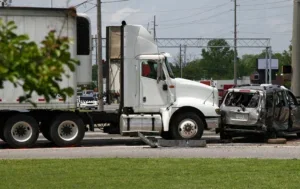
An 80,000-pound semi-truck weighs up to 30 times more than a standard passenger car.1 When a commercial big rig rear-ends traffic on the 710 freeway, or a delivery box truck runs a red light in Koreatown, the destruction goes well beyond a totaled vehicle.
If you survived a California crash, accurately calculating your truck accident damages is the only way to avoid medical bankruptcy.
You are likely pushing through painful physical injuries while missing shifts at work. Yet the trucking company’s insurance adjuster wants you to sign a settlement agreement today. That early offer usually covers the ambulance ride and absolutely nothing else.
California law gives you the right to demand compensation for every dollar this crash cost you.
This guide explains exactly what you can claim against a negligent trucking company, from immediate out-of-pocket expenses to long-term medical care.
Key Takeaways
- Economic damages reimburse your exact financial losses, from emergency room billing and ongoing rehab to missed paychecks and vehicle replacement.
- Non-economic damages compensate you for the physical and emotional toll, including severe pain, trauma, and permanent life alterations.
- Courts award punitive damages only when a trucking company acts with proven malice or fraud rather than basic negligence.
- California enforces no statutory damage caps on standard commercial trucking settlements or jury verdicts.
- Surviving family members can file a separate legal claim for wrongful death damages to recover funeral expenses and lost financial support.
- Under California’s pure comparative negligence law, sharing partial blame for the crash reduces your final payout but does not destroy your case.
3 Types of Damages in a California Truck Accident Claim
California courts categorize commercial trucking compensation into economic, non-economic, and punitive damages.
Economic damages reimburse your literal out-of-pocket costs. Non-economic damages compensate you for the daily physical agony and permanent bodily changes. The final category, punitive damages, exists purely to punish a grossly negligent freight company.
Most Los Angeles claims settle using only the first two.
Winning punitive damages requires hard proof of outright recklessness. A prime example is a carrier forcing a driver to forge hours-of-service logs just to meet an impossible Long Beach port delivery deadline.
Documenting your physical and financial losses requires entirely different legal work than proving who is liable in a truck accident. Liability names the responsible party. Damages determine the exact dollar amount that party owes you.
Let’s break down the types of damages in a truck accident claim.
Economic Damages: Verifiable Financial Losses and Out-of-Pocket Costs
California law allows you to recover economic damages (also known as special damages) to reimburse your exact financial losses.
Insurance adjusters require hard proof for every dollar claimed.
Your attorney will submit specific documents like W-2 tax forms for lost income and detailed hospital billing records to establish your medical baseline.
Past and Future Medical Care
Medical billing typically forms the largest part of a commercial truck crash settlement. Your claim covers the initial ambulance ride and emergency trauma care at a facility like Los Angeles General Medical Center.
It also pays for long-term physical recovery. For example, a spinal cord injury might require a motorized wheelchair and months of intensive physical therapy.
This legal category ensures the at-fault party pays for those ongoing treatments along with your daily prescriptions.
A fair settlement must also account for future medical needs. Personal injury attorneys hire life care planners to calculate these upcoming expenses.
These professionals project the exact cost of future surgeries and necessary home modifications so you avoid paying out of pocket later.
Lost Wages and Diminished Earning Capacity
Missing work makes paying Southern California rent difficult. You have the right to demand reimbursement for every paycheck you missed while recovering in the hospital.
Permanent physical limitations trigger a different calculation called loss of future earning capacity.
Imagine a union dockworker at the Port of Long Beach who suffers a crushed shoulder in a trucking collision. If doctors limit them to light duty, their high-paying maritime career is over.
That worker can claim the financial difference between their projected lifetime union earnings and the lower wages of a desk job.
Your attorney proves this gap using historical tax forms and projections from a vocational expert.
Property Damage
Property damage compensation reimburses the market value of a totaled passenger car or pays for certified body shop repairs.
The trucking company’s insurance policy must also cover the contents of your vehicle.
If a rear-end crash on the 101 Freeway destroys a MacBook on your passenger seat or ruins a Nuna infant car seat in the back, the at-fault freight carrier owes you the precise replacement cost for those items.
Out-of-Pocket and Household Expenses
Incidental expenses multiply quickly after a commercial collision. You can claim reimbursement for the Uber or Lyft fees required to reach orthopedic appointments across Los Angeles traffic.
This category also pays for required household help. If physical restrictions force you to hire outside childcare or pay a local landscaper for yard work you normally handle yourself, you can recover those exact costs.
Insurance adjusters require hard proof before reimbursing daily expenses. You must save every single receipt.
Non-Economic Damages: Physical Pain and Permanent Lifestyle Changes
In California, non-economic damages (often called general damages) compensate you for the physical trauma and psychological toll of a commercial vehicle accident.
Because you cannot submit a standard invoice for these losses, your attorney must prove them through other evidence.
Insider Accident Lawyers builds this portion of your claim using comprehensive medical charts and clinical psychological evaluations.
Witness testimony from family members also helps show the insurance adjuster exactly how the crash altered your daily routine.
Pain and Suffering
Pain and suffering damages compensate you for the actual physical agony caused by your injuries.
A successful claim covers the immediate trauma of broken bones and the ongoing ache of nerve damage after a highway collision.
How long this pain lasts directly dictates the financial value of your settlement.
For example, a traumatic brain injury causing daily migraines and brain fog results in a higher payout than a neck injury that heals after a few months of chiropractic visits.
The law requires insurance companies to pay for the time you spend hurting.
Emotional Distress and PTSD
Surviving a commercial truck crash often leaves lasting mental trauma.
California law provides compensation for emotional distress and PTSD to cover diagnosed psychological conditions resulting from the collision.
You might experience panic attacks when merging onto the 405 Freeway or struggle with insomnia from accident flashbacks.
Your attorney proves these claims using clinical records and treatment plans from licensed psychiatrists. This medical documentation carries much more weight with an insurance adjuster than your personal testimony alone.
Loss of Enjoyment of Life
Loss of enjoyment of life compensates you for the difference between your active lifestyle before the crash and the physical limitations you face today.
A serious injury often forces you to abandon hobbies that define your identity.
If a pelvic fracture permanently prevents you from hiking Griffith Park trails or coaching a Pasadena youth soccer team, that specific loss holds direct financial value in your claim.
Loss of Consortium
Loss of consortium is a separate claim your legally married husband or wife files alongside your personal injury lawsuit.
This action compensates your spouse for the loss of physical intimacy, household support, and daily partnership caused by your injuries.
The state recognizes that a negligent trucking company harms your marriage just as directly as it harms your physical health.
Disfigurement and Scarring
Disfigurement and scarring damages assign a specific financial value to permanent physical marks based on how they affect your confidence and daily social life.
A tanker explosion on the I-5 can leave victims with burns requiring multiple skin grafts.
Juries and insurance adjusters weigh how these permanent visible changes restrict your interactions and alter your future when calculating your final payout.
Punitive Damages: Financial Penalties and Corporate Deterrence
Unlike your other claims, punitive damages do not reimburse your medical bills or lost wages.
Instead, the courts use them to punish a trucking company for reckless behavior and warn other carriers against making the same choices.
Winning this type of compensation requires clearing a very high legal bar.
The Legal Standard for Misconduct
Under California Civil Code § 3294, your attorney must prove the defendant acted with malice, oppression, or fraud.2
Ordinary carelessness does not meet this standard.
If a driver simply misjudges a blind spot on the 101 Freeway, the court views that as a standard mistake. That error alone will not trigger a financial penalty.
Actions That Justify Punitive Penalties
To win these damages, you must prove the company intentionally disregarded public safety.
Consider a logistics corporation running routes out of the Port of Los Angeles. If dispatchers knowingly force drivers to skip federally mandated sleep breaks to meet shipping quotas, they cross the line into punishable behavior.
Juries also penalize companies that order employees to falsify driving logs.
The same rule applies to a maintenance supervisor who intentionally ignores failing brakes on a semi-truck scheduled to haul cargo down the steep Cajon Pass.
Proportionality and Award Limits
California does not place a strict dollar cap on punitive damages. However, the final penalty must remain roughly proportional to the money you receive for your actual financial and physical losses.
Courts treat these awards as the exception in trucking litigation rather than the rule.
Juries use them specifically to penalize a corporation’s dangerous culture rather than focusing on the individual injuries you suffered in the crash.
Wrongful Death Damages: Family Compensation and Loss of Financial Support
A wrongful death claim allows a surviving spouse, domestic partner, or children to seek compensation after a fatal truck crash.3
Unlike a personal injury lawsuit that pays a surviving victim, this claim replaces the financial and emotional support your loved one provided to your household.
Funeral and Burial Expenses
Final expense compensation covers the immediate costs of a funeral.
Your claim reimburses out-of-pocket expenses for memorial services, burial plots, cremation, etc.
It also pays for the ambulance fees and emergency hospital bills incurred between the crash and your family member’s passing.
Lost Financial Support and Household Services
If a fatal crash takes a primary earner, the surviving family can claim their projected lifetime wages.
You can also recover lost union pension benefits and employer healthcare contributions.
The law also compensates you for daily household services. You can recover the exact cost of hiring outside childcare or property maintenance your loved one previously managed.
Loss of Companionship and Guidance
Family members are also compensated for the permanent absence of their loved one.
It pays a widow or widower for the loss of physical intimacy and daily partnership.
It also compensates surviving children for the missing parental guidance and mentorship they will need as they grow up.
Punitive Damages are Restricted in Wrongful Death Claims
California courts generally prohibit punitive damages in standard wrongful death cases.
This rule applies no matter how recklessly the trucking company acted.
Because these restrictions are strict, an attorney handling wrongful death claims focuses on analyzing the crash evidence to maximize the compensatory damages your family receives instead.
How California’s “Pure Comparative Negligence” Law Affects Your Claim
California handles shared fault in commercial collisions using pure comparative negligence.
This rule means you can still recover compensation even if you partially caused the crash. The court simply reduces your total award by your exact percentage of blame.
For example, if a jury values your damages at $200,000 after a truck accident on the I-10 but determines you were 20% at fault for speeding, your final recovery becomes $160,000.
The law never completely bars you from a settlement just because you are partially at fault.
Corporate insurance adjusters weaponize this rule. They will actively try to assign you extra blame during the investigation to shrink the final check they owe.
How Are Truck Accident Damages Calculated?
Attorneys and insurance adjusters don’t guess at settlement values. They use specific financial formulas and the hard evidence in your case file to determine the final number.
The Multiplier Method
Adjusters first add up your exact financial losses, like hospital bills and missed paychecks.
They multiply that total by a number (usually between 1.5 and 5, depending on the severity and lasting impact of your injuries) to calculate your non-economic damages.
A permanent spinal injury receives a much higher multiplier than a broken wrist.
The Per Diem Approach
Some claims use a daily rate instead of a multiplier.
Your attorney assigns a specific dollar value to your daily physical pain and multiplies it by the number of days you spend recovering under a doctor’s care.
Commercial Policy Limits
The trucking company’s insurance policy sets the maximum available funds.
Federal law requires interstate freight carriers to carry at least $750,000 in coverage.1
This provides a much larger potential payout than a standard car accident claim.
Documentation Quality
Formulas mean nothing without proof.
A strong case file built with W-2 tax forms, financial projections, and medical testimony forces the insurance company to accept the higher end of the calculation.
Truck Accident Damages FAQ
What types of damages can I recover in a truck accident claim?
California truck accident claims generally fall into three categories. Economic damages cover medical bills, lost wages, and property damage. Non-economic damages cover pain and suffering and emotional distress. In rare cases involving extreme conduct, punitive damages may also apply.
What’s the difference between economic and non-economic damages?
Economic damages pay for losses you can document with bills, receipts, or pay stubs. Non-economic damages pay for harm that doesn’t come with a price tag, like physical pain or loss of enjoyment of life.
Can you get punitive damages in a California truck accident case?
Only in limited cases. You need clear and convincing evidence that the trucking company or driver acted with malice, oppression, or fraud, not just ordinary negligence.
Is there a cap on damages in a California truck accident claim?
Generally, no. California doesn’t cap compensatory or punitive damages in a standard injury case.
Can I still recover damages if I was partially at fault for the accident?
Yes. Under California’s pure comparative negligence rule, your compensation is reduced by your percentage of fault. You’re not barred from recovering altogether.
What damages can my family recover if a loved one died in a truck accident?
Surviving family members can generally pursue funeral and burial costs, lost financial support, and loss of companionship through a wrongful death claim. Punitive damages usually aren’t part of that type of case.
Secure Fair Compensation with Insider Accident Lawyers
Commercial trucking insurers know what a catastrophic crash actually costs. Their priority is protecting their bottom line. Adjusters often push early settlement offers that completely ignore your future medical needs and lost wages.
You need an advocate to calculate and demand your total damages. Whether your collision happened in Downtown LA, the San Fernando Valley, or Long Beach, our California truck accident lawyers build your case on hard evidence. We deal with the corporate lawyers and insurance tactics so you do not have to.
Get clarity on what your claim is truly worth. Contact Insider Accident Lawyers for a free, no-obligation consultation. We don’t get paid unless you do.
References
- “Pocket Guide to Large Truck and Bus Statistics.” Federal Motor Carrier Safety Administration, U.S. Department of Transportation, https://www.fmcsa.dot.gov/safety/data-and-statistics/commercial-motor-vehicle-facts. Accessed 5 Aug. 2026.
- “Civil Code Section 3294.” California Legislative Information, State of California, https://leginfo.legislature.ca.gov/faces/codes_displaySection.xhtml?sectionNum=3294.&lawCode=CIV. Accessed 5 Aug. 2026.
- “Code of Civil Procedure Section 377.60.” California Legislative Information, State of California, https://leginfo.legislature.ca.gov/faces/codes_displaySection.xhtml?sectionNum=377.60.&lawCode=CCP. Accessed 5 Aug. 2026.
About the Author

Jerome Garo
Jerome Garo is a Legal Content Writer at Insider Accident Lawyers, where he turns personal injury law into clear, practical guidance for people recovering after an accident. He has written legal content for U.S. law firms and spent years writing/editing search-focused articles across tech, healthcare, finance, and other complex fields. With a background in communication, copyediting, and SEO, Jerome cuts through legal jargon and explains what readers need to know in plain English.