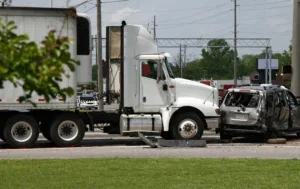
An 18-wheeler wreck can turn an ordinary drive into a life-changing event in a matter of seconds. When a passenger vehicle collides with a tractor-trailer, the difference in size, weight, braking distance, and the height difference between vehicles can make the consequences especially catastrophic. Injuries may require emergency treatment, surgery, rehabilitation, time away from work, or long-term care. And while you are trying to recover, you may also find yourself dealing with trucking companies, insurance adjusters, medical bills, and a whole lot of paperwork.
So, what should you do after an 18-wheeler wreck? How do you determine who was responsible? What evidence matters? And can you recover compensation for your injuries and losses?
At Insider Accident Lawyers, we believe understanding your rights should not require a law degree and three cups of coffee to power through a legal textbook. We’re here to explain what to know after a truck crash, including common causes of an 18-wheeler wreck, potential sources of liability, important evidence, insurance issues, and the types of compensation that may be available after a serious collision.
Key Takeaways
- An 18-wheeler wreck can involve multiple potentially responsible parties, including the truck driver, trucking company, manufacturer, or another third party.
- Common causes include driver fatigue, distracted driving, speeding, unsafe lane changes, inadequate training, improper loading, and violations of trucking regulations.
- Federal regulations govern many aspects of commercial trucking, including driver hours-of-service, vehicle inspections, and maintenance.
- Evidence can disappear after a crash, so photographs, witness information, police reports, medical records, electronic data, and trucking records can all be important.
- Trucking companies and their insurers have legal teams investigating soon after the crash. Preserving evidence can therefore be particularly important.
- California truck accident claims can involve complicated questions about negligence, insurance coverage, comparative fault, and applicable state and federal regulations.
What Is an 18-Wheeler Wreck?
An 18-wheeler is a common term for a large tractor-trailer combination. The tractor provides the engine and cab; the trailer carries the cargo. Pretty simple. Depending on the configuration, a commercial truck may actually have more or fewer wheels than the nickname suggests, but “18-wheeler” remains the phrase most people use.
An 18-wheeler wreck can happen in many ways.
A passenger vehicle is struck from behind by a truck. A truck could drift across a lane and sideswipe another vehicle. A car might become trapped under a trailer in an underride crash. A truck could jackknife, roll over, or lose some or all of its cargo.
The consequences can be severe because large commercial trucks are substantially heavier than ordinary cars.
In fact, the Federal Motor Carrier Safety Administration, or FMCSA, found that of the 503,000 large truck crashes reported to the police in the US in 2022, 5,279 were fatal and 114,000 involved injuries. 1
In other words, these crashes are not simply “bigger car accidents”. They can involve an entirely different set of safety regulations, evidence, insurance policies, and potentially liable parties.
What Should You Do After An 18-Wheeler Wreck?
After any serious collision, your first priority should be safety and medical care.
If you are physically able to do so, move to a safe location away from traffic. Call 911 and request emergency medical assistance when necessary. Even if you initially feel relatively ok, consider getting evaluated by a medical professional.
Adrenaline is a strange little creature. It can temporarily mask pain, meaning an injury that seems fine immediately after the crash may become much more noticeable later.
You should also:
Call the Police
A police report can provide an important record of what happened. Officers may document the location, vehicles involved, visible damage, road conditions, statements from drivers and witnesses, and other observations.
Do not assume that because the vehicles can be driven away, the crash does not need to be reported.
Seek Medical Treatment
Follow medical advice and keep records of your appointments, diagnoses, prescriptions, procedures, and other treatment.
Medical records can help document both the nature of your injuries and the treatment you required after the collision.
Photograph the Scene
If you can safely do so, photographs may capture evidence that later becomes difficult or impossible to recreate.
Consider photographing:
- Vehicle damage
- The truck and trailer
- License plates
- Road conditions
- Traffic signs and signals
- Skid marks
- Debris
- Visible injuries
- Nearby intersections
- Cargo that appears to have shifted or spilled
- Damage to guardrails, barriers, other property
Think of your phone as a tiny evidence-gathering machine. Just do not risk stepping into traffic to get a good shot.
Collect Witness Information
If anyone saw the crash, obtain their name and contact information if possible.
Independent witnesses may be able to provide information about what happened before the collision, including speed, lane position, sudden lane changes, braking, or other driving behavior.
Be Careful with Insurance Information
You should report the accident as required by your insurance policy, but be cautious about giving recorded statements or discussing fault before you understand your rights.
You do not want to accidentally minimize your injuries or speculate about what caused the crash.
And if an insurance representative calls with a friendly “just checking in,” remember that friendly and financially beneficial are not necessarily the same thing.
Why Are 18-Wheeler Wrecks So Complicated?
A typical two-car collision may involve two drivers and two insurance companies.
An 18-wheeler wreck can involve a small parade of people and companies.
Depending on the circumstances, potential parties may include:
- The truck driver
- The trucking company
- The owner of the tractor
- The owner of the trailer
- A leasing company
- A freight broker
- A shipping company
- A maintenance provider
- A parts manufacturer
- A cargo-loading company
- Another motorist
- A government entity responsible for road conditions
Determining who is legally responsible requires looking beyond the fact that a truck was involved.
For example, suppose a truck driver loses control because the brakes were improperly maintained. The driver may not be the only person whose actions matter. The trucking company or maintenance provider could potentially have responsibilities relating to inspections, repairs, or maintenance.
That is why investigating an 18-wheeler wreck often requires looking at the entire chain of events.
What Causes an 18-Wheeler Wreck?
Truck crashes can happen for many reasons. Some involve straightforward driver errors. Others involve problems with training, maintenance, scheduling, or equipment.
Here are some common causes.
Driver Fatigue
Driving a massive commercial vehicle while tired can be dangerous.
Federal hours-of-service rules are designed to limit how long certain commercial drivers can remain on duty and behind the wheel. 2
For property-carrying drivers, the regulations generally include an 11-hour driving limit following 10 consecutive hours off duty, and drivers may not drive after the 14th hour since they started driving, even if they took a few hours’ worth of breaks in the middle and the 11-hour limit has not yet been reached. Drivers must also take a 30-minute break after eight cumulative hours of driving under the applicable rules.
If a truck driver was excessively fatigued when a collision occurred, investigators may examine driving schedules, electronic logging information, dispatch records, and other evidence.
Distracted Driving
Truck drivers can become distracted just like anyone else.
Possible distractions include:
- Cell phones
- Navigation systems
- Eating
- Drinking
- Adjusting controls
- Looking away from the road
- Interacting with passengers
- Reaching for objects
In a few seconds of distraction, a fully loaded tractor-trailer can cover a surprising amount of asphalt when moving at freeway speeds.
Speeding
Speed matters in every crash, but it can be particularly significant when a heavy commercial vehicle is involved.
A truck traveling too fast may have less time to react and more difficulty stopping safely.
Investigators may examine vehicle data, roadway evidence, witness accounts, surveillance footage, and other information to determine how fast the vehicles were traveling.
Unsafe Lane Changes
Trucks have large blind spots and require significantly more room to maneuver.
An unsafe lane change can result in a sideswipe or other serious collision.
This can be especially dangerous when a smaller vehicle is positioned alongside the trailer.
Following Too Closely
Large trucks need significant stopping distance.
If a driver follows another vehicle too closely, a sudden stop ahead may leave insufficient room to avoid a collision.
Rear-end crashes involving commercial trucks can cause serious injuries to occupants of smaller vehicles.
Improperly Loaded Cargo
Cargo must be loaded and secured appropriately.
If cargo shifts during transportation, it can affect the truck’s stability and handling. Cargo can also fall from a vehicle and create a hazard for other motorists.
An investigation may therefore look at how cargo was loaded, secured, inspected, and transported.
Mechanical Problems
A truck’s brakes, tires, steering components, lights, suspension, and other systems need to function properly.
Mechanical failures can contribute to devastating crashes.
If defective or poorly maintained equipment played a role, determining who was responsible for inspecting, maintaining, repairing, or manufacturing that equipment may become an important part of the investigation.
Who Can Be Responsible for an 18-Wheeler Wreck?
One of the biggest questions after an 18-wheeler wreck is who can legally be held responsible.
The answer depends on the evidence.
The Truck Driver
This is the most obvious source of liability. A driver may be liable if negligent conduct caused the crash.
Examples could include speeding, distracted driving, unsafe lane changes, driving while impaired, or violating applicable safety regulations.
The Trucking Company
The trucking company may potentially be responsible for its own negligence, or depending on the circumstances or applicable law, for the conduct of its employees.
Issues may include:
- Negligent hiring
- Inadequate training
- Poor supervision
- Unsafe scheduling
- Failure to maintain vehicles
- Pressure to meet unrealistic delivery deadlines
- Failure to follow safety procedures
A company may also possess important evidence about the crash.
The Maintenance Company
Some trucking companies outsource maintenance.
If a maintenance provider failed to properly inspect or repair a safety-critical component, that company’s conduct may become relevant.
The Cargo Loader
Improperly loaded or secured cargo can create serious hazards.
If another company was responsible for loading the trailer, investigators may need to determine whether the cargo was properly distributed and secured.
A Manufacturer
Sometimes the problem is not poor maintenance. It may involve a defective part or vehicle component.
Depending on the circumstances, product liability laws may apply.
Another Driver
Not every truck crash is caused by the truck.
Another motorist may have made an unsafe lane change, stopped suddenly, crossed into traffic, or otherwise contributed to the collision.
That is one reason why investigation matters. The goal is to determine what the evidence shows rather than just pointing at the largest vehicle in the crash.
What Evidence Matters After an 18-Wheeler Wreck?
With that in mind, it’s no wonder that evidence is one of the most important parts of a truck accident investigation.
And unfortunately, evidence does not always wait patiently.
Some information can be lost, overwritten, discarded, or become harder to obtain as time passes.
Potentially important evidence may include:
Electronic Logging Data
Commercial drivers subject to hours-of-service requirements generally maintain records relating to their duty status.
These records may establish how long a driver had been working or driving before a crash.
Truck Inspection and Maintenance Records
Maintenance documents can potentially reveal:
- Prior mechanical problems
- Repairs
- Inspections
- Tire issues
- Brake problems
- Recurring defects
- Missed maintenance
Driver Qualification Records
Depending on the case, investigators may examine information relating to the driver’s qualifications and training, driving history, and employment.
Black Box or Event Data
Some commercial vehicles contain electronic systems that may record information relevant to a crash.
The specific information available depends on the vehicle and equipment.
Dashcam and Surveillance Footage
Video may come from:
- The truck itself
- Other vehicles
- Traffic cameras
- Nearby businesses
- Homes
- Security systems
Video can be especially useful as it may provide a clearer picture of what happened immediately before impact.
Cell Phone Records
If distracted driving is suspected, phone records or other evidence may become relevant, subject to applicable requirements.
Cargo Records
Bills of lading, loading documents, inspection records, and other transportation records may help establish who handled the cargo and how it was loaded.
Accident Reconstruction
In serious cases, accident reconstruction professionals may analyze photographs, vehicle damage, roadway evidence, vehicle data, witness statements, and other information to help determine how the collision occurred.
What Injuries Can Result From an 18-Wheeler Wreck?
Because of the forces involved, an 18-wheeler wreck can cause a wide range of injuries.
These may include:
- Broken bones
- Traumatic brain injuries
- Spinal cord injuries
- Back and neck injuries
- Internal injuries
- Organ damage
- Crush injuries
- Burns
- Lacerations
- Amputations
- Shoulder injuries
- Knee injuries
- Soft tissue injuries
- Psychological trauma
Some injuries are immediately obvious. Others are not.
A person may walk away from a crash thinking they are fine, only to experience increasing pain, headaches, dizziness, numbness, or other symptoms hours or days later.
That’s why medical evidence is crucial even when the injury doesn’t initially seem drastic.
What If You Were Partly at Fault?
California law follows a comparative negligence system.
That means that the fact you may have partially contributed to the accident doesn’t necessarily mean you automatically lose the ability to recover compensation.
However, your percentage of responsibility can affect the amount you ultimately recover.
Truck accident cases can become complicated when multiple drivers, companies, or other parties may have contributed to a collision.
For example, imagine a truck driver was speeding, but another driver simultaneously made an unsafe lane change.
The investigation may need to determine what each person’s conduct contributed to the crash.
Why Trucking Claims Can Be Different
Commercial trucking insurance can be more complicated than an ordinary passenger vehicle claim.
A trucking company may have substantial liability coverage, and there may be multiple insurance policies depending on who owned the truck, who operated it, who leased it, and what cargo was being transported.
There may also be insurers representing different potentially responsible parties.
This can create a complicated web of claims and coverage questions.
The existence of insurance doesn’t mean that an insurer will automatically offer an amount that fully reflects an injured person’s losses. Insurance companies are businesses. Their job is to evaluate claims according to their policies and applicable law.
Your job is to protect your interests.
How Long Do You Have to File an 18-Wheeler Accident Claim in California?
California has strict deadlines for filing personal injury lawsuits, known as statutes of limitations.
In general, you have two years from the date of the accident to file a claim. However, the applicable deadline can depend on the nature of the claim and the parties involved.
Different rules may apply in situations involving government claims, minors, or other circumstances.
Because missing an applicable deadline can seriously affect your ability to pursue a claim, it is important not to assume unlimited time simply because the insurance claim is still being negotiated.
If you have been injured in an 18-wheeler wreck, speaking with a California personal injury attorney early can help you understand how deadlines and procedures may apply to your situation.
Should You Talk to the Trucking Company’s Insurance Company?
You will most likely be contacted by the trucking company’s insurer in what seems like a suspiciously short time after the collision.
That is not unusual.
Large trucking companies and their insurers often have established procedures for investigating crashes.
You should be truthful, but avoid guessing about facts you do not know.
For example, you do not need to announce that you are “probably fine” if you are still experiencing symptoms. You also don’t need to speculate about your medical prognosis immediately after a serious crash.
If the insurer wants a recorded statement, asks you to sign a release, or makes a settlement offer, consider getting legal advice before agreeing to anything.
Once a settlement is finalized, you may be giving up the ability to pursue additional compensation later.
Don’t Rush to Settle
A quick settlement can sound appealing when you suddenly have a wrecked car and huge medical bills to deal with.
An insurance check can look like a lifeboat.
But before accepting an offer, it is important to understand the full extent of your injuries and losses.
Some injuries require months or years of treatment. Some affect a person’s ability to work. Others permanently change how they live their lives.
You generally want to understand what you are giving up before signing away your rights.
How an 18-Wheeler Accident Lawyer Can Help
A truck accident attorney can investigate the circumstances surrounding the collision and identify the evidence needed to build a claim.
Depending on the case, that investigation may include:
- Reviewing police reports
- Gathering medical evidence
- Collecting photographs and videos
- Identifying witnesses
- Examining truck maintenance records
- Reviewing driver records
- Investigating hours-of-service compliance
- Examining available electronic vehicle data
- Reviewing cargo documentation
- Investigating trucking company practices
- Communicating with insurers
- Identifying liable parties
- Calculating damages
- Negotiating a settlement
The important point is that a truck accident investigation should look at more than the dent in your bumper; it should look at why the crash happened.
Frequently Asked Questions About an 18-Wheeler Wreck
What should I do immediately after an 18-wheeler wreck?
Get to a safe location if possible, call 911, seek medical attention, document the crash, exchange information, identify witnesses, and preserve photographs and other evidence. Avoid admitting fault or speculating about what caused the collision.
Who is liable for an 18-wheeler wreck?
Liability depends on the circumstances. Potentially responsible parties can include the truck driver, trucking company, vehicle maintenance company, cargo loader, manufacturer, or other motorist.
Can I sue a trucking company after an accident?
Yes, if the trucking company’s negligence or the conduct of its employee contributed to the crash, you are able to pursue a claim. The specific legal basis depends on the facts of the case.
What if the truck driver was tired?
Fatigue can be relevant to a truck accident investigation. Federal hours-of-service regulations establish limits on driving and on-duty time for many commercial drivers. Investigators may examine records to determine whether applicable requirements were followed.
What if the truck driver says I caused the crash?
A driver’s statement is only one piece of evidence.
Police reports, photographs, witness accounts, video, vehicle data, physical evidence, and other records may provide additional information about what happened.
Can I still recover compensation if I was partially responsible?
California’s comparative negligence rules may allow a partially responsible person to recover damages, although the amount can be reduced based on a person’s share of the responsibility. The specific circumstances matter.
How much is an 18-wheeler accident worth?
There is no standard value for an 18-wheeler accident claim.
The potential value depends on factors including the severity of the injuries, medical expenses, lost income, future losses, pain and suffering, property damage, liability, available insurance coverage, and other circumstances.
Do I need a lawyer after an 18-wheeler wreck?
You are not automatically required to hire an attorney. However, truck accident cases can involve multiple parties, extensive evidence, complicated insurance issues, and federal and state regulations.
Getting legal advice can help you understand your options and the issues involved in your claim.
So What Should You Do After an 18-Wheeler Wreck?
An 18-wheeler wreck can leave you dealing with much more than a damaged car.
You may be facing serious injuries, medical bills, lost income, rehabilitation, emotional distress, and an insurance process that feels like a full-time job you never applied for.
The circumstances behind the crash matter.
Was the driver distracted or fatigued? Was the truck speeding? Was the cargo properly secured? Was the vehicle properly maintained? Did another driver contribute? Did a company fail to follow required safety procedures?
These questions make a significant difference in determining who may be responsible.
If you or someone you love has been injured in an 18-wheeler collision in California, Insider Accident Lawyers can help you understand the legal issues surrounding your case and investigate the circumstances that led to the crash.
After all, when a giant truck collides with a much smaller vehicle, the aftermath is anything but minor.
References
- Federal Motor Carrier Safety Administration. “Large Truck and Bus Crash Facts 2022.” S. Department of Transportation, 10 Oct. 2025, www.fmcsa.dot.gov/safety/data-and-statistics/large-truck-and-bus-crash-facts-2022-1#Trends.
- “Summary of Hours of Service Regulations.” Federal Motor Carrier Safety Administration, U.S. Department of Transportation, fmcsa.dot.gov/regulations/hours-service/summary-hours-service-regulations. Accessed 30 Sept. 2026.
- California, Legislature. California Vehicle Code, section 22406. Justia Law, 2025, law.justia.com/codes/california/code-veh/division-11/chapter-7/article-2/section-22406/.
About the Author

Emily Stone is a professional non-fiction content creator and journalist. As a Legal Content Writer at Insider Accident Lawyers, she specializes in translating complex legal topics into engaging and accessible content. She holds a B.A. in Creative Writing from York St John University in the United Kingdom (though she’s now LA-based) and is passionate about helping readers better understand their legal options through informative, reader-friendly writing.